
The well-planned wine room
Serving Tray or Trolley Beside Your Wine Cellar?
Compare a serving tray with a trolley for the area beside your wine cellar: actual glassware, route, landing surfaces, model limits and the place it stays afterward.
Start here
At a glance
Start with a serving tray for a small setup over a straightforward route when you have somewhere suitable to put it down. Consider a trolley when you host regularly, want another serving surface and the approved route and parked position work with your room. Check actual glassware fit and the maker's limits; neither a headline load rating nor wheels establish that a particular arrangement is suitable.
You want to join the tasting, not keep fetching things
Friends are coming to see the cellar. The glasses are in the kitchen, the bottles are ready to choose and you can already picture the trips back for everything you forgot. Would a serving trolley make the evening easier, or would a tray do just as well?
We'd start with a tray when you're carrying a small setup over a straightforward route and already have somewhere to put it down. Consider a trolley when regular hosting gives it a useful job and the route, parked position and actual items all fit. If you serve beside existing kitchen storage, you may need neither.
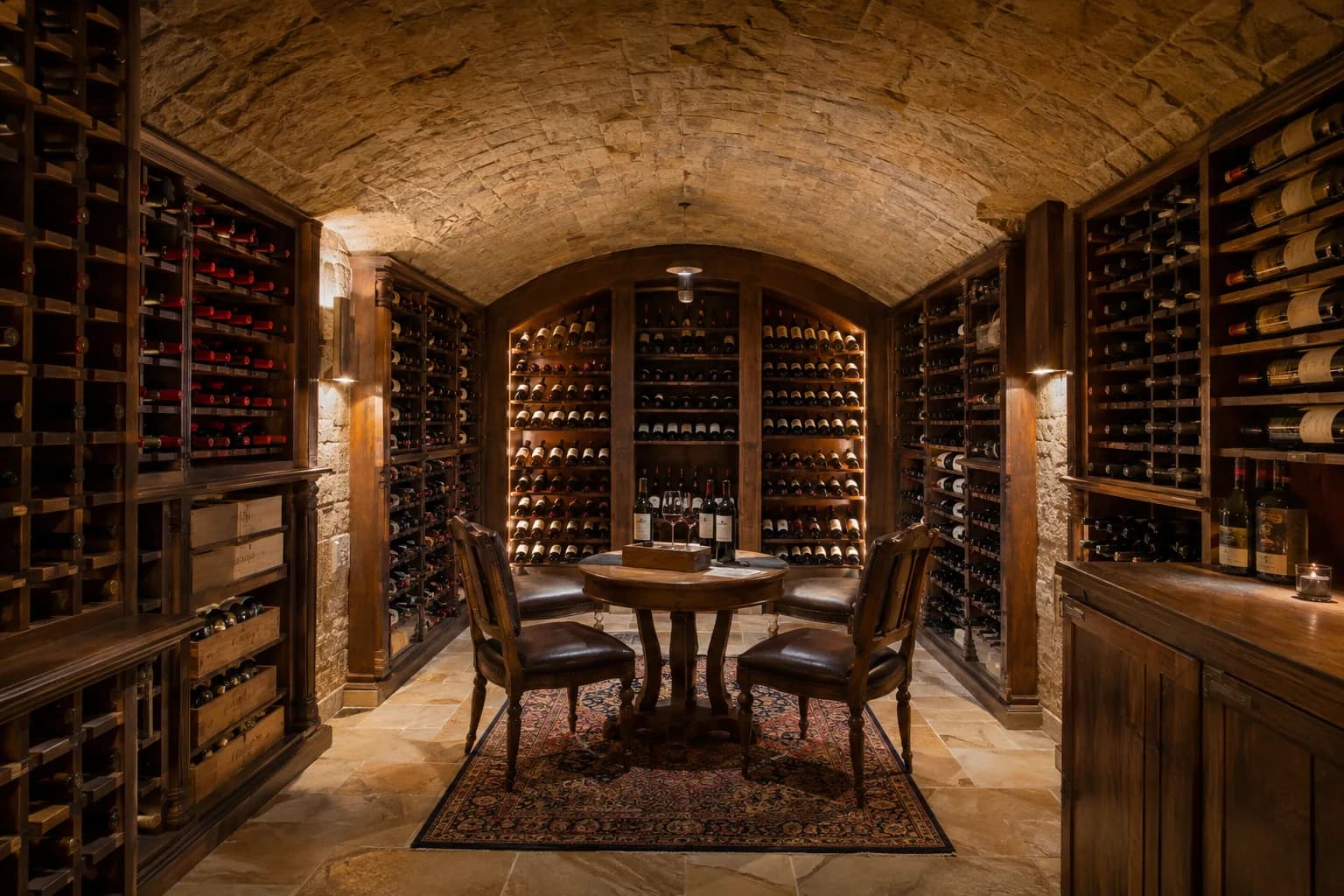
This is a choice for the adjoining tasting area. Don't assume ordinary serving furniture belongs inside a cooled wine enclosure; leave any interior proposal to the cellar designer. Our tasting-area guide covers where to sit. Here the question is how you bring the things you need to that seat.
Walk the route before choosing the furniture
Start where clean glasses and serving pieces live. Follow the route to the tasting table and back with used items. Notice doors you must open, changes of level and where people sit. Ask the designer to show how the proposed furniture works with those ordinary movements.
A trolley needs a usable route and a place to remain while people are seated. If you would have to lift it over a step or move a guest every time you pass, wheels haven't resolved the problem. Ask the supplier to demonstrate the actual arrangement; don't assume a compact outer measurement makes every route workable.
A tray needs a suitable landing surface at each end. Picture setting it down before opening the cellar door or making space on the table. If there is nowhere convenient for that, decide whether a nearby serving surface would help more than another mobile piece. Keep circulation and cellar access with the project designer.
A tray is a useful first comparison
IKEA's GRÖNFISK is a current example of a handled serving tray. The maker describes it for carrying plates and glasses and gives overall dimensions of 18 by 12 inches. Its handles fold down when the tray is set down. Those details establish an actual alternative to a trolley, without telling you how many of your glasses fit.
Lay out the pieces you normally bring together and compare them with the usable surface of the proposed tray. The outside dimensions include edges and fittings; a tall glass, a decanter and a bottle create a different arrangement from several small cups. Ask about the intended load and handling directions rather than treating any rectangular surface as a serving tray.
Choose a manageable setup and make more than one trip when appropriate. We haven't tested these products, and a handle doesn't establish spill resistance or a safe carrying load. If carrying is the part you want to avoid, discuss that need with the supplier rather than simply ordering a larger tray.
A trolley buys another surface as well as wheels
A mobile cart may be useful if you want serving pieces to stay beside the table through the evening. IKEA's current RÅSKOG utility cart illustrates a compact option with lockable castors. The maker specifies indoor use, a 13-pound limit per shelf and a 40-pound overall limit. Those are model-specific limits, not a recommended wine-serving load.
The same product is not approved for direct food contact. If you plan to serve snacks, choose appropriate dishes and confirm the proposed use with the supplier. A photograph of an attractive cart isn't enough to decide what belongs on its surfaces.
Check the usable shelf dimensions and the room above each shelf with the actual bottles, stemware and other pieces. Ask for the assembly and operating instructions, including how the castors are used. Keep every stated limit; a total capacity figure doesn't give permission to exceed an individual shelf limit.
Compare a general utility cart with a purpose-made serving trolley if presentation or access is important to you. You may prefer a broader upper surface or a different handle arrangement. Ask to see those features working rather than paying for a style label alone.
What happens to it between gatherings?
Decide whether the trolley will stay on display, live under a surface or return to another room. Show that parked position on the layout. A piece that has to be emptied and moved somewhere inconvenient after every gathering may add a chore you didn't intend to buy.
A tray may tuck away more easily, but it still needs a home that fits its handles and overall shape. If you already own a suitable one, try planning around it before adding another purchase. Your dedicated glass cabinet can remain the main storage; mobile serving furniture doesn't have to hold the whole collection.
Compare delivered and assembled prices, care requirements, current return terms and any room work needed to make the arrangement useful. Don't justify a trolley by an imagined crowd if you usually share one bottle with two people. Equally, if you host regularly and want everything within reach, a convenient serving surface can be a pleasure worth paying for.
Buy for the evening you actually host
Keep a tray when the route and a small setup work comfortably. Choose a trolley when its extra surface and mobility solve a repeated inconvenience, and the approved arrangement fits the room. Keep both purchases optional if your existing setup already lets you enjoy your guests.
Our vetted cellar experts bring experience and relationships with providers. Tell us where you like to host and what feels awkward about serving there. We can help you discuss the tasting area alongside the cellar design, so the small furniture decisions follow the room you want to enjoy.
Sources & editorial notes
Prepared by Cellar Builder Guide editorial team. Updated November, 2026.
Prepared independently by the editorial team. No supplier paid for inclusion or influenced this guide.
- GRÖNFISK tray with handle, bamboo/white, 205.790.66, IKEA US (accessed 2026-11-19)
- RÅSKOG utility cart, white, 305.867.83, IKEA US (accessed 2026-11-19)